Pinyin and tones, in colour
Pinyin writes Chinese pronunciation in Latin letters. A small mark on each syllable shows the tone. With one colour per tone, children and adults can see the melody of a word before saying it.
What is pinyin?
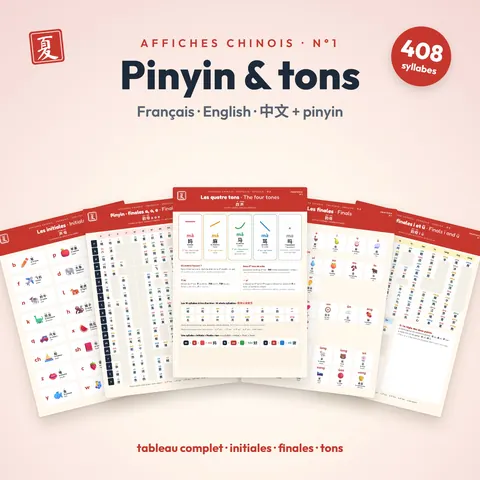
Pinyin 拼音 pīnyīn is the official way of writing Mandarin pronunciation with the Latin alphabet. Each syllable has an initial (the starting consonant, like b, m, zh) and a final (the vowel part, like a, ao, ang). There are 23 initials and just over 400 syllables in all.
Pinyin does not replace characters: it is written above them as a reading aid.
The four tones and the neutral tone
- 1st tone, ā: high and level. mā 妈 mum.
- 2nd tone, á: rising, like a question. má 麻 hemp.
- 3rd tone, ǎ: dips then rises. mǎ 马 horse.
- 4th tone, à: falling sharply, like a command. mà 骂 to scold.
- neutral tone, a: short and light, no mark. ma 吗 turns a sentence into a question.
All five together make a sentence learners know well: 妈妈骂马吗? māma mà mǎ ma “Is mum scolding the horse?”
A gesture for each tone
For children, a gesture helps feel the tone: the hand glides flat for the 1st tone, rises diagonally for the 2nd, draws a dip for the 3rd and drops for the 4th. You can also “draw” the tone in the air with a finger while saying the word.
Where does the mark go?
The tone mark sits on the main vowel: on a or e if there is one (hǎo, bèi), on o in ou (gǒu), and on the second vowel in iu and ui (liù, guì).
When the tone changes
Two 3rd tones in a row: the first is said as a 2nd tone. 你好 is written nǐ hǎo but said “ní hǎo”.
一 yī becomes yí before a 4th tone (一个 yí gè) and yì before other tones (一天 yì tiān). 不 bù becomes bú before a 4th tone (不是 bú shì).
Dictionaries usually mark the original tone; some children’s textbooks mark the spoken tone. To start with, hearing the difference is what matters.
Our colour code
On Printoxia cards, posters and books, pinyin always uses the same code: red for the 1st tone, orange for the 2nd, green for the 3rd, blue for the 4th and grey for the neutral tone. Every file includes the key.
Frequently asked questions
How many tones does Chinese have?
Mandarin has four tones plus a neutral tone. Cantonese has more.
Why colour the tones?
Colour is seen before the small mark is read: it helps remember the melody of a word, especially for children and beginner adults.
Is pinyin read like English?
Not always. For example, “q” sounds close to “ch” in “cheese”, “x” close to “sh”, “zh” close to “j” in “jam”, and “c” like “ts” in “cats”. The pinyin chart gives an example word for every sound.